













Nigeria’s power generation utilisation stood at 85 per cent in October 2026, with average hourly generation reaching 4,047 megawatts (MW), the Nigerian Electricity Regulatory Commission (NERC) has said.
NERC disclosed this in its October 2026 Operational Performance Fact Sheet, published on its official X handle on Wednesday.
The factsheet breaks down how Nigeria’s grid-connected power plants performed during the month.
According to the factsheet, average available capacity stood at 4,744 MW during the period, while average hourly generation was 4,047 MW. This, it said, indicates that 85 per cent of available generation capacity was utilised in the month.
“Average available capacity stood at 4,744 MW, with an average hourly generation of 4,047 MW, indicating that 85 per cent of available generation capacity was utilised,” it said.
Top energy producers
The factsheet listed Jebba_1 as the highest-performing plant by load factor in October.
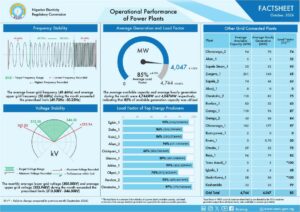
Jebba_1 recorded a load factor of 99 per cent, generating 423 MW out of an available 429 MW.
It was followed by Omotosho_1 at 97 per cent, with 179 MW generated out of 183 MW available, and Afam_2 at 94 per cent, with 371 MW generated out of 395 MW available.
ALSO READ: Pension assets key to Nigeria’s $1 trillion economy target – PenOp
The load factor measures how consistently a plant generated power relative to its available capacity during the period.
Frequency, voltage outside limits
Despite the high utilisation, the factsheet showed that grid stability indicators exceeded the prescribed operational limits during the month.
The average lower grid frequency was 49.46 Hz, while the average upper grid frequency was 50.66 Hz. Both were outside the prescribed operational limits of 49.75 Hz to 50.25 Hz.
Similarly, the monthly average lower grid voltage was 305.00 kV, while the average upper grid voltage was 353.94 kV. Both were outside the prescribed operational limits of 313.50 kV to 346.50 kV.