










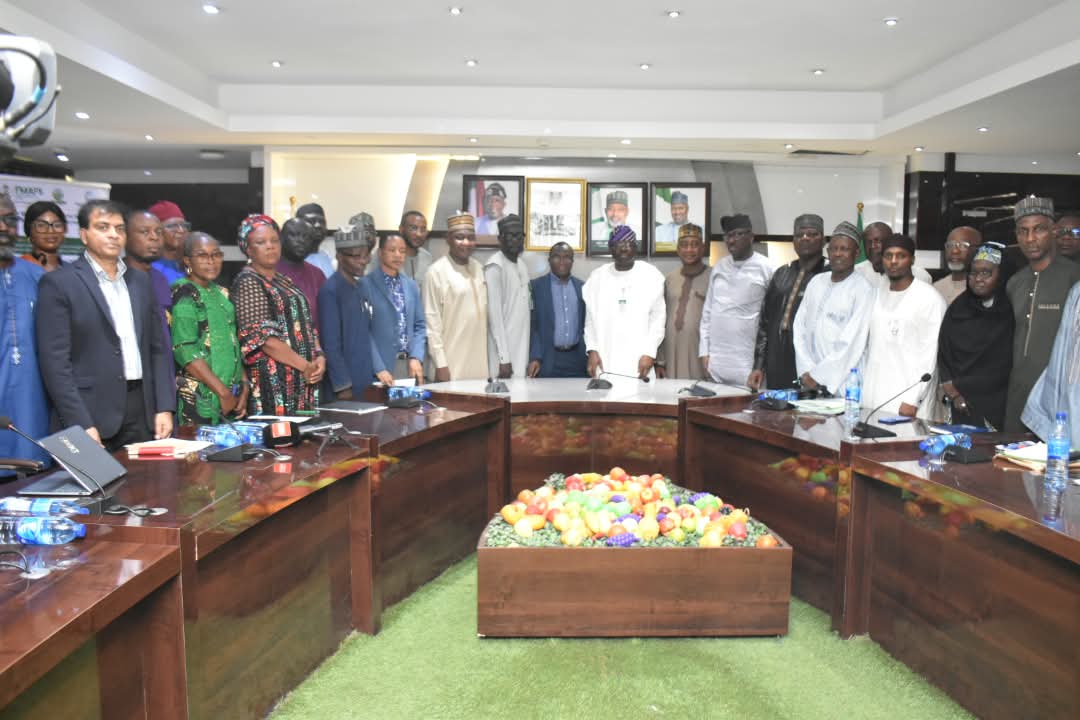
The federal government has inaugurated a Joint Technical Working Committee on Digital Agriculture Architecture and Data Integration under Agriculture Value Chains for Growth AGROW Project, Component 2.2 to unify Nigeria’s digital agriculture systems.
This was disclosed in a statement by the Head, Information Department of the Ministry of Agriculture and Food Security, Ezeaja Ikemefuna on Thursday.
Speaking at the inauguration on Thursday, according to the statement, the Minister of Agriculture and Food Security, Abubakar Kyari, said the assignment is about strengthening the way Nigeria serves its farmers by connecting existing systems, developing national farmer and farm registry procedures, and turning farm data into practical services.
Mr Kyari, represented by the Permanent Secretary of the Ministry, Marcus Ogunbiyi said farmers are more than producers of food.
“They are entrepreneurs, employers, investors in their communities and the foundation of our food system, when farmers are equipped to produce more reliably and reach markets, the whole nation benefits,” Mr Kyari said.
He noted that the farmer must remain at the centre of national development efforts, stressing that under the Renewed Hope Agenda of President Bola Tinubu agriculture is central to food security, jobs, economic growth and national prosperity.”
He added that reliable information is critical to supporting farmers, because if the government knows who farmers are, where their farms are, and what conditions they face, it can plan better and connect them with relevant services.
According to him, good information can help improve extension services, target assistance, strengthen market links, and provide useful weather, soil and water advice, noting that the systems holding this information must be accurate, secure and coordinated.
Mr Kyari disclosed that the Committee’s work follows the National Strategic Dialogue held in Abuja on September 29 and 30, 2026, which brought together Federal and State institutions, technical partners and other stakeholders.
He explained that the dialogue called for a national approach that connects and improves existing systems, supports reliable farmer and farm records, and enables States to lead registration and routine updates within shared standards.
“Its task is to build a sound technical foundation for digital agriculture and ensure that the systems we develop respond to real needs in the field,” he said.
What the Committee must do
To achieve this, Mr Kyari charged the committee to begin with a thorough review of existing Federal, State and partner systems.
He said the review should establish who manages each system, what information it contains, how reliable and current the records are, what it costs to operate, and how it can connect with other systems.
Beyond the review, he said the committee must also develop clear procedures for the farmer and farm registry, explaining how a farmer is linked to each farm or plot, how identity and farming activity are verified, how records are corrected and updated, and how farmers can be enrolled in areas with limited connectivity.
He emphasised that the approach must recognise the important role of States in registration and routine updates while maintaining common national standards.
On trust, Mr Kyari stated that it will determine whether farmers and institutions use the systems.
“Farmer information must be protected and used for clearly defined purposes,” he said.
He directed the committee to recommend appropriate rules for data access, sharing, retention and security, with special care for identity information and precise farm locations, stressing that any live data exchange must follow the required approvals and agreements.
He noted that the ambition must extend beyond collecting and connecting data, and urged the committee to work with NiMet, soil and agricultural research institutions, water agencies, extension services and states to identify reliable information and determine how useful advice can reach farmers through extension officers, SMS, radio and suitable digital or offline channels.
He also emphasised that the services must be accessible to women, young people and underserved communities.
“The committee will work to the milestones in the implementation plan, which include a validated inventory of existing systems, a core farmer and farm data model, an initial architecture and standards package, proposals on data governance, state readiness and PBC 1 procedures, a costed operating model, and a consolidated roadmap with proposed updates to the Project Implementation Manual,” the statement said.
In addition, the minister said pilot registration and early services in ready states should proceed only when the necessary procedures, readiness, financing and approvals are in place.
He urged members to bring the knowledge and commitment of their institutions to the work, attend meetings, provide timely technical input, and make responsibilities, deadlines and unresolved issues clear.
He reminded the committee that it is a technical coordination and advisory body and as such, must respect the mandates of participating institutions and submit recommendations to the authorities responsible for formal decisions.
“This discipline will help us build a programme that is credible, accountable and capable of lasting beyond the project,” he said.