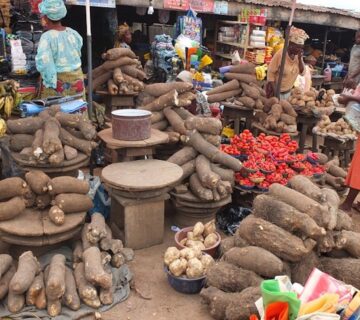













![Nigerian food market [Photo credit: The Guardian NG]](https://thepreviewmedia.com/wp-content/uploads/2026/05/Nigeria-Food-market0.jpg)
Nigeria’s annual inflation rate rose to 15.69 per cent in April from 15.38 per cent in March 2026, the National Bureau of Statistics (NBS) said on Friday.
The statistics office said the April 2026 headline inflation rate showed an increase of 0.31 per cent compared to the March 2026 headline inflation rate.
On a month-on-month basis, the NBS said the headline inflation rate in April 2026 was 2.13 per cent, which was 2.05 per cent lower than the rate recorded in March 2026 (4.18 per cent).
This, it said, means that in April 2026, the rate of increase in the average price level was lower than the rate of increase in the average price level in March 2026.
The NBS said the Consumer Price Index (CPI) increased to 138.3 in April 2026, reflecting a 2.9-point increase from the preceding month (135.4).
Inflation indicators compare prices of goods and services over 12 months. Nigeria has experienced a sharp increase in food prices in recent years. This trend worsened in 2023 following President Bola Tinubu’s removal of petrol subsidies and adopting a floating exchange rate for the naira.
READ ALSO: Nigeria recorded 2,720 road accidents in Q1 2026 — NBS
This shift has led to a steep increase in the cost of staple food, pushing many Nigerians further into poverty and heightening food insecurity.
Food inflation
The NBS said the food inflation rate in April 2026 was 16.06 per cent on a year-on-year basis and stood at 24.68 per cent in the same month of the preceding year (April 2025).
On a month-on-month basis, it said the food inflation rate in April 2026 was 3.63 per cent, down by 0.54 per cent points from March 2026 (4.17 per cent).
The bureau said the increase can be attributed to the rate of change in the average prices of millet whole grain, yam flour, ginger (fresh), beef, garri, yam tuber, pepper (fresh), cray fish, cassava tuber, beans, irish potatoes, tomatoes (fresh), wheat grain (sold loose), soy beans, guinea corn, plantain, carrots (fresh) etc.
It added that the average annual rate of food inflation for the twelve months ending April 2026, relative to the previous twelve-month average, was 17.55 per cent, which was 17.05 per cent points lower than the average annual rate of change recorded in April 2025 (34.60 per cent).