


The year began on a positive note with the Nigerian government initiating the construction of five Mini-Liquefied Natural Gas (LNG) plants in Ajaokuta, Kogi State, as part of the ‘Decade of Gas’ agenda.
The government also awarded ten gas distribution licences to six companies to boost gas utilisation and energy supply.
However, the Dangote Refinery’s petrol sales in Naira saga took centre stage, with the refinery suspending sales due to crude allocation issues, only to resume after government intervention.
In a great development, the country’s upstream oil sector witnessed a dramatic turnaround, with crude oil losses from theft and metering issues dropping to their lowest levels in nearly 16 years.
A feud between Dangote Refinery and the Petroleum and Natural Gas Senior Staff Association of Nigeria (PENGASSAN) led to a nationwide strike, which was later suspended after government intervention.
In this report, ThePreview Media presents a breakdown of the key events that shaped the year.
Flags off 5 Mini LNG plants
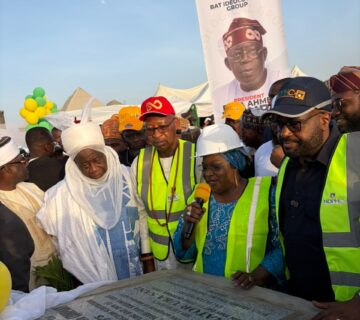
In January, the Nigerian government performed the groundbreaking ceremony of five Mini-Liquefied Natural Gas (LNG) plants in Ajaokuta, Kogi State.
The five Mini LNG plants include PRIME LNG, NGML/Gasnexus LNG, BUA LNG, Highland LNG, and LNG Arete. According to the Nigerian National Petroleum Company Limited (NNPC Ltd), the project aims to deliver a cost-effective, long-term, dedicated, secure and reliable natural gas solution to industrial and commercial customers.
The Mini-LNG project, according to NNPC Ltd, is a multifaceted virtual pipeline development in line with the federal government’s ‘Decade of Gas’ agenda.
NNPC Ltd has a stake in three of the five mini-LNG plants (90 per cent in Prime LNG, 50 per cent in NGML/Gasnexus LNG and 10 per cent in BUA LNG), while Highland LNG and LNG Arete are developed by other private companies.
Gas distribution licences awarded
On 28 January, the Nigerian government awarded 10 gas distribution licences (GDL) to six companies to improve the country’s gas utilisation drive.
The beneficiary companies are NNPC Gas Marketing Limited, Shell Nigeria Gas Limited, Axxela, NIPCO Plc, Central Horizon Gas Company and Falcon Corporation Limited.
The GDL, as provided in Sections 148-152 of the Petroleum Industry Act (PIA), according to the government, is a licence that gives exclusive right to establish, construct and operate a gas distribution system in a designated local Gas Distribution Zone (GDZ) issued to qualified applicants to distribute gas at the ‘last mile’.
Dangote Refinery petrol sales in Naira saga
On 10 March 2025, NNPC Ltd said the contract for the sale of crude oil in Naira was structured as a six-month agreement, subject to availability, and expires at the end of March 2025.
At the time, the NNPC said discussions were currently ongoing towards implementing a new contract.
Reacting to reports alleging unilateral termination of the crude oil sale agreement between NNPC and Dangote Refinery, the Nigerian government on 11 March said the policy framework enabling the sale of crude oil in naira for domestic refining remains in force.
On 19 March, the Dangote refinery announced the temporary suspension of sales of petroleum products in Naira.
The refinery said the decision is necessary to avoid a mismatch between its sales proceeds and its crude oil purchase obligations, which are currently denominated in dollars.
In April, a meeting between a presidential delegation and officials of the Dangote refinery, the NNPC Ltd and other parties agreed to extend the policy of selling Nigerian crude to local refineries in naira.
The meeting also resolved that the policy, including the sale of the products obtained from such crude in naira, will not have a terminal date.
On 27 September, the refinery announced the suspension of petrol sales in naira, effective 28 September. According to the refinery, the decision was made due to the refinery selling petroleum products in excess of its Naira-Crude allocations, making it unsustainable to continue petrol sales in Naira.
However, after intervention by the Naira for Crude Technical Committee chairman on 27 September, the refinery announced the resumption of petrol sales in naira, effective immediately.
Oil theft drops
Over the years, the country has been grappling with crude oil theft and pipeline vandalism, but there’s some good news this year.
In February, the Nigerian Upstream Petroleum Regulatory Commission (NUPRC) said that oil theft in Nigeria had significantly reduced to 5,000 barrels per day (bpd), leading to a steady production increase of 1.7 million bpd at the time.
The NUPRC attributes this success to a combination of kinetic and non-kinetic interventions, including increased military presence, the use of surveillance technology, and collaboration with local communities.
In September, the NUPRC said the country’s upstream oil sector witnessed a dramatic turnaround, with crude oil losses from theft and metering issues dropping to their lowest levels in nearly 16 years.
The commission said between January and July 2025, crude oil losses were contained at 2.04 million barrels, averaging 9,600 barrels per day over the seven months.
It said the entire 2024 calendar year recorded 4.1 million barrels lost at a daily average of 11,300 barrels, noting that in the first seven months of 2025, losses were cut by 50.2 per cent, with only 2.04 million barrels lost over the period.
Oil theft, though reduced, has continued despite the establishment of several security apparatus involving various security agencies.
Dangote vs PENGASSAN crisis
The feud between Dangote refinery and many other key players in the downstream petroleum sector deepened in the year.
A face-off between PENGASSAN and Dangote Refinery began after the refinery terminated the appointments of some of its workers, citing repeated acts of sabotage that have raised significant safety concerns and affected operational efficiency.
In a letter endorsed by Femi Adekunle, a human resource manager at the Dangote Group, the corporation told the affected employees of the management’s decision to discontinue their service, effective from 25 September.
Following the sack, PENGASSAN asked its members to disrupt activities at the refinery by blocking the gas supply to it.
The union directed its members nationwide to withdraw their services in protest against the alleged sack of Nigerian workers at the Dangote Refinery from midnight on 28 September.
The union also accused the management of the refinery of anti-labour practices and discrimination against local employees, prompting the federal government’s intervention.
In a swift response, Dangote refinery described the order as illegal and cautioned PENGASSAN to obey Nigerian laws in its operations, noting that PENGASSAN has no legal right to disrupt or interfere with the refinery’s contracts with third-party vendors for gas and crude oil supply.
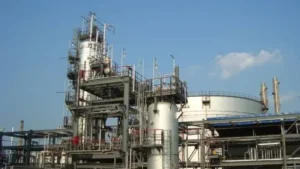
Dangote refinery called on the federal government and its security agencies to intervene and call PENGASSAN to order, urging that the union’s actions are not only lawless but also have the potential to inflict significant harm on the Nigerian economy and citizens.
On 27 September, the House of Representatives Committee on Petroleum Resources (Downstream) called on PENGASSAN to suspend its directive to cut off gas and crude oil supply to the Dangote refinery.
On 28 September, the federal government appealed to PENGASSAN to suspend its planned nationwide strike over its dispute with the Dangote Refinery.
On 29 September, the National Industrial Court, Abuja, issued an interim order stopping PENGASSAN from continuing its nationwide industrial action against the Refinery. The court also restrained PENGASSAN from cutting crude and gas supply to Dangote Refinery.
However, this newspaper reported on 29 September that PENGASSAN shut down the major entry points of the NNPC Ltd, Nigerian Midstream and Downstream Petroleum Regulatory Authority (NMDPRA), and the NUPRC.
On 1 October, PENGASSAN suspended its nationwide strike against the Dangote Refinery after reaching an agreement with the management following a reconciliation meeting facilitated by the Nigerian government.
NNPC shake-up
Earlier in April, President Bola Tinubu sacked the board of the NNPC Ltd, including its Group Chief Executive Officer (GCEO), Mele Kyari, and board chairperson Pius Akinyelure.
The president also approved Bayo Ojulari as the new GCEO of the NNPC and Ahmadu Kida as non-executive chairman. NNPC also announced the appointment of a new 8-member senior management team.
In the same April, NNPC sacked the managing directors of the three state-owned refineries. The company also directed management staff with less than a year to retirement to proceed with their exit.
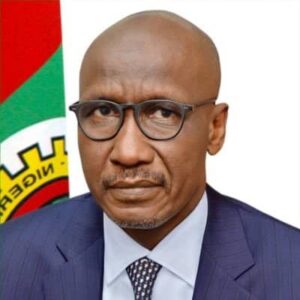
In June, Olufemi Soneye, the then Chief Corporate Communications Officer of the company, announced his decision to step aside from his role.
In September, the company announced the appointment of Andy Odeh and Morenike Adewunmi to key leadership positions.
Mr Odeh assumed the role of Chief Corporate Communications Officer, while Mrs Adewunmi was appointed Chief Relations Officer.
Port Harcourt/Warri Refineries shutdown
The Warri Refinery, which was reopened in December 2024, shut down in January due to safety issues.
In November 2024, the Port Harcourt refinery commenced production after a long period of rehabilitation, but in May 2025, NNPC announced the shutdown of the refinery.
15% tariff duty
In October, Mr Tinubu approved a 15 per cent import duty on petrol and diesel. The government stated that the directive aimed to “strengthen local refining capacity, and ensure a stable, affordable supply of petroleum products across Nigeria.”
The tariff would have ensured that imported petrol is not cheaper than that of the Dangote refinery, which produces virtually all of Nigeria’s locally produced petrol.
At the time, the government said implementation of the tariff would begin in about a month, following the request by the chairman of the revenue agency, Federal Inland Revenue Service (FIRS), Zacch Adedeji, whose memo triggered the presidential approval.
The policy was, however, met with criticism from various stakeholders, energy experts and civil society groups, who argued it would lead to higher fuel prices and worsen the country’s economic situation.
Following the approval, Dangote refinery, the largest oil refiner in the West African country, said there was no need for petrol import, adding that it produces enough petrol and diesel for local consumption.
On 13 November, the Nigerian government said the implementation of a 15 per cent import duty on petrol and diesel is “no longer in view”.
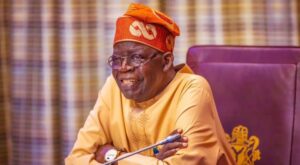
Dangote/NMDPRA boss corruption allegations
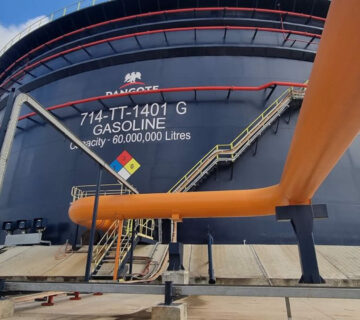
On 14 December, President and Chief Executive of Dangote Industries Limited, Aliko Dangote, accused Farouk Ahmed, the then NMDPRA chief executive, of economic sabotage, which he said is undermining domestic refining in Nigeria.
Speaking at a press conference at the Dangote Petroleum Refinery, at the time, he accused the leadership of the NMDPRA of colluding with international traders and oil importers to frustrate local refining through the continued issuance of import licences for petroleum products.
Mr Dangote claimed that Mr Ahmed was living beyond his legitimate means, claiming that four of his children attend secondary schools in Switzerland at costs running into several million dollars. He said such expenditure raised serious questions about potential conflict of interest and the integrity of regulatory oversight in the downstream petroleum sector.
On 15 December, he expanded his allegations, accusing Mr Ahmed of corruption and misappropriation of public funds, providing detailed figures for his children’s education abroad.
According to him, Mr Ahmed spent about $5 million on secondary education and upkeep over six years, and an additional $2 million on tertiary education, including $210,000 for Faisal Farouk’s 2025 Harvard MBA.
On 16 December, Mr Dangote submitted the petition through his lawyer, Ogwu Onoja, a Senior Advocate of Nigeria (SAN), calling for Mr Ahmed’s arrest, investigation, and prosecution for allegedly living above his means as a public officer.
The petition, addressed to the Independent Corrupt Practices and Other Related Offences Commission (ICPC) Chairman Musa Aliyu, alleged that Mr Ahmed “spent without evidence of lawful means of income amounting to over $7 million for the education of his four children” in Switzerland. It provided the children’s names, schools, and specific amounts for verification.
Mr Dangote further accused Mr Ahmed of using his position to embezzle public funds, prompting protests from civil society groups.
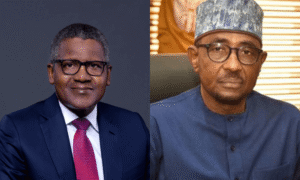
He cited section 19 of the ICPC Act, which empowers the commission to investigate and prosecute corrupt practices, noting that a successful prosecution could result in a five-year jail term without an option of fine.
He urged the ICPC to act decisively, stressing that he remained available to provide evidence supporting his claims.
On 17 December, Mr Ahmed said that while he is aware of the “wild and spurious allegations” made against him and his family, and the frenzy they have generated, he has chosen not to engage in public debate.
On the same day, Mr Tinubu replaced Mr Ahmed and Gbenga Komolafe, the chief executive of NUPRC. The presidency said both resigned their positions.
Oil blocks bidding
Earlier in December, NUPRC opened bidding for 50 oil and gas blocks, targeting $10 billion in investment.
Announcing the commencement of the oil block licensing round at the time, the then NUPRC Chief Executive, Mr Komolafe, said the bidding would add 2 billion barrels of oil output over the next decade.
He said the 2025 block licensing round would last for approximately six months.
Renaissance/shell assets acquisition
In March, Renaissance Africa Energy completed the acquisition of the entire equity holding in the Shell Petroleum Development Company of Nigeria (SPDC).
The company, at the time, said this follows the signing of a sale and purchase agreement with Shell in January 2024 and the obtaining of all regulatory approvals required for the transaction.
Launch of Africa’s first gas trading platform
In December, the Nigerian government launched Africa’s first gas trading licence, clearing house, and settlement authorisation platform aimed at enabling efficient, transparent, and swift trading of natural gas.
The initiative led by the NMDPRA in collaboration with the Securities and Exchange Commission (SEC) granted licenses to JEX Markets Limited to establish and operate the online platform for gas trading and exchange.
At the time, Ekperikpe Ekpo, Minister of State for Petroleum Resources (Gas), said the platform would pave the way for smooth natural gas business, transparent pricing, efficient price determination, and secure payment mechanisms that align seamlessly with the national energy policies and global best practices.
READ ALSO: 2025 Review: Key events that shaped Nigeria’s power sector
Outlook
Speaking with ThePreview Media, Dan Kunle, an energy expert, said the Nigerian oil sector is expected to experience significant growth in 2026, with production targets set at 2.5 million barrels per day.
Mr Kunle expressed cautious optimism about the sector’s prospects, emphasising the need to fast-track upstream assets to achieve the production goal.
“We also expect that all the upstream assets that we have, we expect that by the first quarter of 2026, all those assets will have been offered and the government will earn some reasonable money from the signature bonus and also encourage the investors to accelerate their investment in exploration and development,” he said.
He highlighted the importance of the downstream sector, stating that the new regulator in midstream downstream regulator is expected to carry out a forensic audit on the importation volume and quality of petrol.
Furthermore, he called for the privatisation of the country’s refineries, which he described as “technically and financially insolvent”.
“We expect the president of Nigeria to approve the National Council on Privatisation to liquidate all three refineries. I use the word liquidate to privatise all three refineries because they are technically and financially insolvent. They have been bankrupted by the bad leadership of NNPC,” he added.
He said the government has set ambitious targets for the oil sector, and with the right policies and implementation, the country is poised to become a major player in the global energy market.