













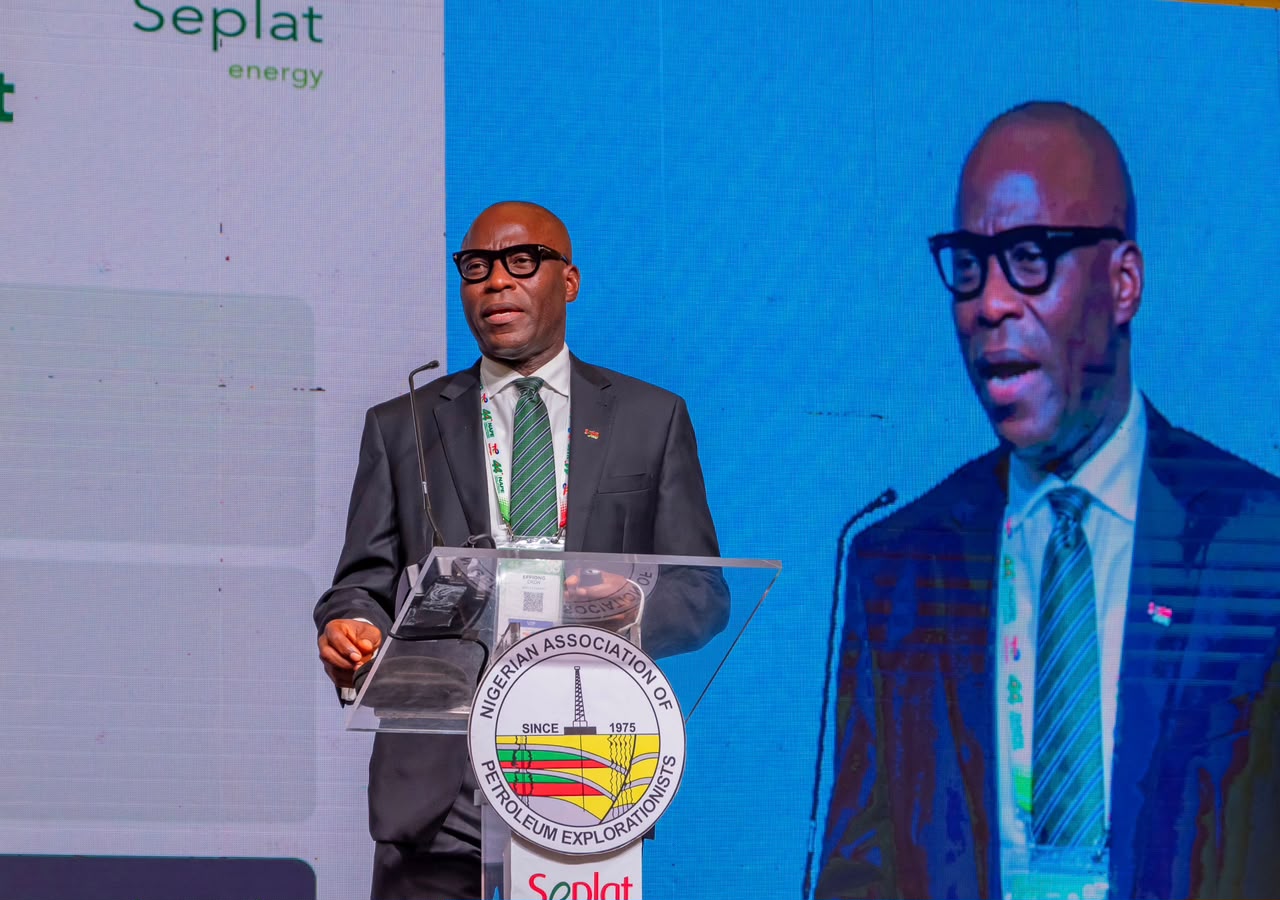
Seplat Energy Plc has called for accelerated exploration, stronger indigenous capabilities, greater deployment of technology and sustained investment across Nigeria’s energy value chain to unlock the country’s hydrocarbon potential and strengthen energy security.
Seplat’s Manager, Corporate Communications & Media Relations, Stanley Opara, disclosed this in a statement on Wednesday.
According to the statement, the Chief Executive Officer of Seplat Energy Plc, Effiong Okon, made the call in keynote addresses delivered during the 44th Nigerian Association of Petroleum Explorationists (NAPE) Annual International Conference & Exhibition (AICE) 2026 in Lagos.
Speaking on the conference opening day, Mr Okon said Nigeria possesses a significant hydrocarbon resource base but must accelerate the conversion of resources and reserves into actual energy production.
“Nigeria is better placed than most. We have a significant resource base and a strategic position in global energy supply. However, a reserve is a promise. A barrel delivered is the result. Our task is to close the distance between the two, and to do it faster,” he said.
He identified exploration, local capability and adaptive technology as three critical levers for growing reserves and production, noting that investments in better seismic imaging, disciplined appraisal and digital technologies can reduce subsurface uncertainty and improve the quality and speed of investment decisions.
90 idle wells restored
Mr Okon highlighted Seplat Energy’s own operations as evidence of the potential for indigenous companies to translate local expertise into increased output.
The company has restored 90 idle offshore wells in less than 24 months, while 41 wells restored in 2026 added gross production capacity of approximately 33,700 barrels of oil and 176 million standard cubic feet of gas per day.
He pointed to the company’s application of machine learning in subsurface evaluation and development planning, as well as successful appraisal programmes at Amukpe and Okporhuru, as examples of combining technology, existing infrastructure and disciplined execution to accelerate resource commercialisation.
He said unlocking additional resources must be supported by a resilient and interconnected energy value chain if Nigeria is to achieve genuine energy security.
He described energy security as a whole-system challenge encompassing upstream production, pipelines, gas processing, refining and petrochemicals, power generation and transmission, as well as a stable policy environment capable of attracting long-term investment.
“Disruption raises the value of dependable supply, and Nigeria is building the capacity to provide it: first for Nigerians, and then for the world,” he said.
He noted that renewed investment across Nigeria’s upstream, gas, midstream, refining and power sectors provides an important opportunity to strengthen domestic energy supply while improving the country’s position within the global energy market.
According to him, the growing investments demonstrate that Nigeria’s energy system is being progressively rebuilt, but announcements and individual projects will only translate into energy security when the different components of the value chain work effectively together.
He identified connection, consistency and Nigerian delivery as three priorities required to translate investment into sustainable energy security.
“Every project is only as valuable as its link to the next point in the chain: well to plant, plant to pipeline, pipeline to power station, and power station to customer,” he added.
For Seplat Energy, he said this principle is reflected in the ANOH Gas Plant and its connection to national gas infrastructure.
“The company achieved its first commercial gas through the OB3 pipeline in September, demonstrating the potential of connecting indigenous investment with strategic national infrastructure.”
Mr Okon stressed the importance of regulatory and policy consistency, noting that capital would continue to flow towards jurisdictions where investors have confidence in the rules and projects can move from investment decisions to execution within predictable timelines.
He called for Nigerian companies, capital, skills and contractors to play an increasingly significant role in the development of the country’s energy resources, ensuring that expansion of the sector creates domestic economic value.
According to Mr Okon, Nigeria’s ultimate objective should go beyond increasing oil and gas production to ensuring that available energy supports industrialisation, employment and wider economic development.
ALSO READ: NUPRC approves 595 well re-entries, 145 new wells in 10 months
“The objective was never security alone. Energy security is the means. Prosperity is the end: power for homes and factories, feedstock for fertiliser and petrochemicals, jobs, and revenue that stays at home,” he said.
He added that natural gas would remain particularly important to Nigeria’s development, providing energy for electricity generation and industry while strengthening the country’s position as a reliable energy supplier.
“The stronger our own system, the more we can contribute to the world’s energy security. National and global energy security are one project,” Mr Okon stated.
Reaffirming Seplat Energy’s commitment to supporting Nigeria’s energy transition and economic development, he said the sector must now concentrate on execution, collaboration and speed.
“A resource in the ground creates potential, but only energy delivered creates prosperity. Our task is to find more, decide faster and deliver sooner. We must connect the investments being made, sustain the momentum and deliver the energy Nigeria needs, so that the country is secure at home and becomes an increasingly dependable partner to the world,” he said.