









The Nigerian Electricity Regulatory Commission (NERC) has said that grid-connected power plants recorded an average hourly generation of 4,102 megawatt-hours (MWh) in February.
NERC disclosed this in its latest Operational Performance Fact Sheet, published on its website on Thursday.
According to the fact sheet, although the country has a total installed generation capacity of 13,625 megawatts (MW), only 4,384MW was available for dispatch on average during the period.
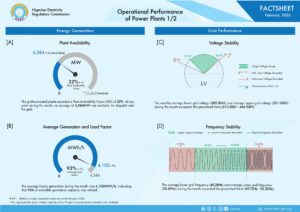
It said that this represented a Plant Availability Factor (PAF) of 32 per cent for the month.
“The grid-connected plants recorded a PAF of 32 per cent. At any point during the month, an average of 4,384MW was available for dispatch onto the grid,” it said.
The commission also noted that the available capacity was largely utilised, as the plants recorded an average load factor of 93 per cent.
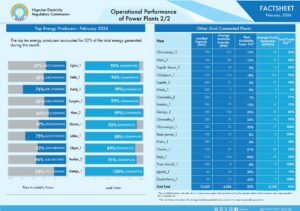
It stated that the position indicated that most of the available generation capacity was dispatched to the national grid.
It noted that the top energy producers: Ihovbor 2, Kainji 1, and Jebba 1 stood out with strong availability and high utilisation levels.
“The monthly average lower grid voltage (302.00kV) and average upper grid voltage (351.00kV) during the month exceeded the prescribed limits (313.50kV – 346.50kV).
“The average lower grid frequency (49.28Hz) and average upper grid frequency (50.69Hz) during the month exceeded the prescribed limits (49.75Hz-50.25Hz),” the report said.
In February, the Nigerian Independent System Operator (NISO) attributed the country’s dwindling electricity generation to inadequate gas supply to thermal generating stations.
At the time, it said given that thermal plants account for the dominant share of Nigeria’s generation mix, any disruption or limitation in gas supply directly affects available generation capacity and overall grid output.
Consequently, it explained that the current energy allocated to Distribution Companies (DisCos) reflects the reduced supply available on the grid.
NISO further explained that when total system generation drops significantly, it must implement load shedding across the system, while dispatching available energy in line with the Nigerian Electricity Regulatory Commission (NERC) Multi-Year Tariff Order (MYTO) allocation percentages across all distribution networks to maintain grid stability and prevent system disturbances.