













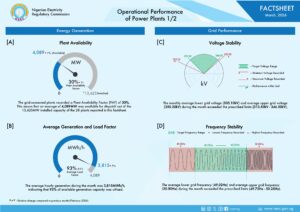
The Nigerian Electricity Regulatory Commission (NERC) has said that grid-connected plants recorded an average hourly generation of 3,815 (MWh/h) in March.
NERC disclosed this in its latest Operational Performance Fact Sheet, published on its official X handle on Thursday.
According to the fact sheet, the country has a total installed generation capacity of 13,625 megawatts (MW), only 4,089MW was available for dispatch on average during the period.
It said that this represented a Plant Availability Factor (PAF) of 30 per cent for the month.
“The grid-connected plants recorded a PAF of 30 per cent. This means that an average of 4,089 MW was available for dispatch out of 13,625 MW installed capacity of the 28 plants reported in the factsheet,” it said.
PAF, according to NERC, is the ratio of the maximum rated output of the plant declared by the operator relative to the maximum rated output specified by the manufacturer.
The commission also noted that the available capacity was largely utilised, as the plants recorded an average load factor of 93 per cent.
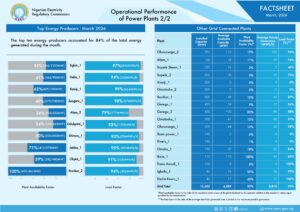
The report noted that the top energy producers: Ihovbor_2, Kainji_1, and Jebba_1 stood out with strong availability and high utilisation levels.
“The monthly average lower grid voltage (305.10kV) and average upper grid voltage (350.20kV) during the month exceeded the prescribed limits (313.50kV – 346.50kV).
“The average lower grid frequency (49.02Hz) and average upper grid frequency (50.80Hz) during the month exceeded the prescribed limits (49.75Hz-50.25Hz),” the report said.
The Nigerian Independent System Operator (NISO) had recently attributed the country’s dwindling electricity generation to inadequate gas supply to thermal generating stations.
NISO said given that thermal plants account for the dominant share of Nigeria’s generation mix, any disruption or limitation in gas supply directly affects available generation capacity and overall grid output.