
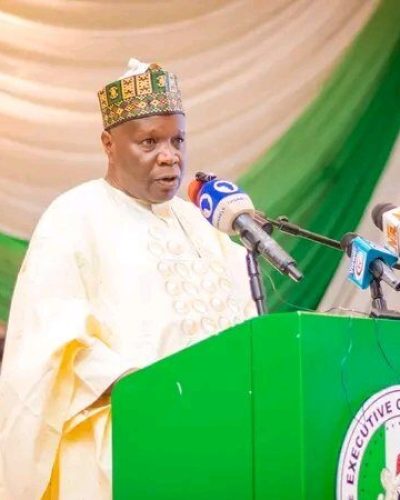






The Group Chief Executive Officer of the Nigerian National Petroleum Company Limited (NNPC Ltd), Bashir Ojulari, said Nigeria has the responsibility to utilise its abundant gas resources to power Africa’s rise and contribute meaningfully to global stability.
Mr Ojulari disclosed this at the opening ceremony of the 9th edition of the Nigeria International Energy Summit (NIES 2026) in Abuja on Tuesday.
He emphasised that the country’s pathway to a prosperous future lies in the ability to leverage its resource abundance, serving as a bridge to a cleaner future, an engine for industrialisation, and a foundation for export-led growth.
“Nigeria’s pathway to a prosperous future lies in our collective ability to leverage our resource abundance, especially as gas sits at the heart of our strategy.
“It is our bridge to a cleaner future, our engine for industrialisation, and our foundation for export-led growth,” Mr Ojulari said.
Speaking further, he said that though the African continent is endowed with vast energy resources, it still grapples with issues of accessibility, affordability, and sustainability, with over 600 million Africans living without access to electricity.
He said with 37 billion barrels of crude oil and 209 trillion cubic feet of gas reserves, Nigeria and the NNPC Ltd are ready to lead the charge in changing the narrative.
ALSO READ: Africa poised for energy renaissance – Sahara Group
“With over 600 million Africans still lacking electricity, the continent’s priority cannot be a copy and paste.
“Ours must be a just, equitable, people-centred energy addition, one that lifts our people out of poverty, powers industries, supports agriculture, transforms transportation, and unleashes the creativity of Africa’s youth,” he added.
He said NNPC Ltd was not just a commercial entity but also a peace and prosperity enabler.
On steps being taken to enhance access to gas as the primary fuel for driving industrialisation and economic growth, he said NNPC Ltd has launched a new Gas Masterplan, while aggressively progressing strategic gas infrastructure projects such as the Obiafu-Obrikom-Oben (OB3), Ajaokuta-Kaduna-Kano (AKK) gas pipelines, and the Escravos-Lagos Pipeline System (ELPS) expansion.
“These projects are more than pipelines; they are highways for economic opportunity,” he said.