














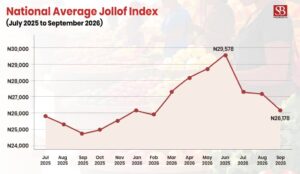
The cost of preparing a pot of jollof rice, a popular delicacy among Nigerians, fell for three months in a row, from N29,578 in June
2026 to N26,178 in September, a report has said.
SB Morgen (SBM) Intelligence, a geopolitical intelligence platform, disclosed the 11.5 per cent fall in the cost of preparing the delicacy in its latest report titled, “The SBM Jollof Index Q3 2026: The Pot Cools, but Not Everywhere ”.
The SBM Jollof Index said the index prices 12 ingredients for one pot of jollof rice, in fixed quantities, in 13 Nigerian markets.
“The cost of cooking a pot of jollof fell for three months in a row, from N29,578 in June 2026 to N26,178 in September. That is an 11.5 per cent fall in one quarter. It is the largest fall we have recorded since we began tracking the index in July 2016,” the report said.
However, it said it is not the longest.
It explained that prices also fell for five months in a row between June and November 2017, and again between November 2018 and May 2019.
“The 2017 and 2018 declines each took about 6 per cent off the index. This one shaved off 11.5 per cent, roughly double the next-largest fall in the series, which was 5.8 per cent in mid-2025,” it said.
What drove the fall
The report said the decline was led by protein and oil, not by staples.
It noted that most of the fall came in a single step between June and July, when the index dropped N2,312, stating that August was flat, down N104.
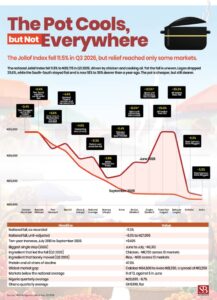
“September gave back a further N984. This is not a gentle slide, but one sharp correction, a plateau, and a second smaller step.”
The official data moved the same way.
Headline inflation eased to 15.39 per cent in August 2026, and food inflation fell to 19.57 per cent from 20.31 per cent in July, its first decline in six months, which the National Bureau of Statistics (NBS) and most analysts attributed to the main harvest reaching the markets.
The Monetary Policy Committee cut the Monetary Policy Rate to 23 per cent in September, its first reduction of the year.
“The Jollof Index moved in the same direction and moved further, which is what we would expect from a basket weighted towards perishables and protein rather than the full consumption basket.”
The report said the fall is real, but it is not national, stating that Lagos and Ibadan account for most of it.
Regional breakdowns
South-west
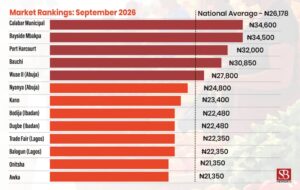
The report said Trade Fair and Balogun fell from N34,700 in June to N22,350 in September, a decline of 35.6 per cent.
This, it said, is the largest quarterly fall recorded in any market since it began tracking.
“It is also, in the other direction, the exact mirror of the Q2 edition, where the same markets recorded the sharpest increase in the country at 49.6 per cent over 12 months.
“The broad-based fall is what gives it credibility. All 12 ingredient lines in Lagos fell
between June and September. Chicken dropped N3,200, beef N2,800, vegetable oil N2,000, pepper N1,150 and tomatoes N950,” it said.
The report said Ibadan’s Bodija and Dugbe markets fell from N28,550 to N22,480, which is 21.3 per cent as recorded and roughly 1.3 per cent once the spice unit correction is applied.
It explained that Ibadan did not experience a crash, and the field confirms it.
“Asked about the protein fall, an Ibadan trader was blunt: the prices “didn’t really reduce”, with chicken at ₦5,000 and beef at N6,000 held through the quarter because production costs had not moved.
“That is exactly what our ingredient lines show for Bodija and Dugbe, and it is the strongest available corroboration that the headline Ibadan number was a unit artefact rather than a market event.”
South-South
The report said the South-South is now, unambiguously, the most expensive region in Nigeria, and the only zone that did not see the quarter’s relief.
It said Calabar Municipal closed September at N34,600, downN150 from June. Bayside Mbakpa closed at N34,500, down N150, noting that Port Harcourt was the only market in the country to rise, from N31,200 to N32,000, an increase of 2.6 per cent.
South-east
The index said Onitsha fell from N22,550 to N21,350 and Awka from N22,050 to N21,350, declines of 5.3 and 3.2 per cent.
“Both are more expensive than a year ago, Onitsha by 5.4 per cent and Awka by 8.1 per cent.”
North-west
The report said Kano fell from N25,820 in June to N23,400 in September, a decline of 9.4 per cent, and is 9.8 per cent cheaper than a year ago.
ALSO READ: Cost of preparing Jollof rice up 19.4% in March – Report
This, it said, is the first meaningful move in a market that spent the entire last reporting period within a band of N24,270 to N25,820.
“The driver is protein. Chicken fell from N7,000 to N4,500, offset partly by beef rising from N4,000 to N5,000. Vegetable oil fell by N800, and onions by N300. Working against the fall, rice rose N450 and pepper N200,” it added.
North-east
The report said Bauchi fell from N32,350 in June to N30,850 in September, a 4.6 per cent decline, and is now 5.2 per cent cheaper than a year ago.
“It has fallen for five consecutive quarters from its mid-2025 peak above N41,000. The quarter’s movement came almost entirely from perishables: pepper down N1,000, onions down N300, tomatoes down N200,” it said.
North-central
It said Nyanya fell from N25,450 to N24,800, down 2.6 per cent, and Wuse II fell from N29,200 to N27,800, down 4.8 per cent.
“Both remain among the most expensive markets in the country, and both are more expensive than a year ago, Nyanya by 9.3 per cent and Wuse II by 4.5 per cent.”
It added that the North Central is the clearest case of a zone that participated in the quarter’s relief only marginally.
“Seasoning fell to N500 from N550 in both markets, vegetable oil fell from N300 to N500, and salt, tomatoes and tinned tomatoes fell by N100 each. Beef in Nyanya rose by N500.”