





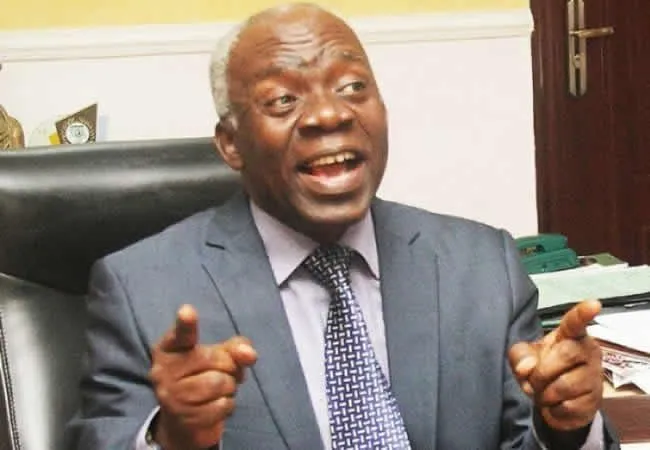
Human rights lawyer, Femi Falana, has sued the Federal Republic of Nigeria at the ECOWAS Community Court of Justice over alleged violations of his fundamental rights during successive military administrations in the 1980s and 1990s.
In the suit marked ECW/CCJ/APP/30/2026 filed in Abuja, Mr Falana, a Senior Advocate of Nigeria, is asking the court to declare that his arrests, detentions, alleged abduction and restrictions on his movement were unlawful.
He is seeking $10 million in damages for alleged violations of his rights to personal liberty, dignity, fair hearing, property and freedom of movement under the African Charter on Human and Peoples’ Rights.
According to the application, Mr Falana’s confrontation with authorities began during his National Youth Service Corps (NYSC) year in Oyo State between 1982 and 1983, when he represented University of Ibadan students charged with conspiracy and attempted murder.
He alleged that the NYSC authorities withheld his discharge certificate because he defended the students without official permission.
“Even though the applicant completed the service, the authorities of the National Youth Service Corps seized his discharge certificate for defending the students without official permission,” the application stated.
1985 detention, 1990 abduction
Mr Falana said in June 1985, armed agents of the then National Security Organisation (NSO) arrested him at the Lagos State High Court and detained him for seven weeks at the NSO facility at 15 Awolowo Road, Ikoyi, in “dehumanising conditions.”
He said he was released on 30 August 1985, after the coup that brought Ibrahim Babangida to power.
The Babangida administration later renamed the NSO as the State Security Service (SSS) and set up a panel led by a former judge, Samson Uwaifo, to investigate detentions.
Mr Falana appeared before the panel but disputed its findings. He said the SSS told the panel his detention was connected to his role in the defence of musician Fela Anikulapo-Kuti, who was prosecuted for foreign exchange offences.
He argued the claim was false, noting that Isola Kanmi-Osobu, who led him in Fela’s defence, was not arrested.
The senior lawyer also alleged that he was abducted from his Lagos home at about 2 a.m. on 8 April 1990 by SSS officials, driven towards Lagos-Epe Road and abandoned in a bush.
He said he found his way to Epe and returned to Lagos. He alleged the SSS denied involvement, and the military government declined his request for investigation.
In October 1991, he alleged the SSS prevented him from travelling to Harare, Zimbabwe, for a human rights conference and seized his international passport for six months.
June 12 and other arrests
Mr Falana further alleged that he, Beko Ransome-Kuti and Baba Omojola were arrested on 19 May 1992, and transferred to Kuje prison in Abuja.
He said Gani Fawehinmi, late human rights lawyer, was also arrested and taken to Kuje after seeking their release.
He claimed a judge ordered his release on 8 June 1992, but the Babangida administration disobeyed the order.
“The Ibrahim Babangida military junta ensured that the order for the applicants’ release was disobeyed without any legal basis,” the suit states.
Falana, Fawehinmi, Ransome-Kuti and Omojola were later charged with conspiracy and treasonable felony over an alleged attempt to overthrow the government.
Mr Falana also said he, Mr Fawehinmi and Mr Ransome-Kuti were arrested and prosecuted after opposing the annulment of the June 12, 1993 presidential election and were charged with conspiracy, sedition and incitement.
He said court orders granting bail were initially disobeyed and they remained in detention until August 1993.
READ ALSO: Nigeria wins $2.35 billion Mambilla arbitration against Sunrise Power
The application cited findings attributed to the United Nations Working Group on Arbitrary Detention and reports by Amnesty International concerning some of the arrests.
Mr Falana argued that Mr Babangida’s acknowledgement in his 2025 memoir, ‘A Journey in Service’, that Moshood Abiola won the June 12 election is significant because activists were arrested for challenging the annulment.
He alleged he faced further arrests and detention between 1994 and 1998 over his human rights advocacy, labour activities and work on the trial of Ken Saro-Wiwa and other MOSOP leaders.
In March 1998, he said he and nine others were arrested after he delivered a paper at a labour workshop and were charged with conspiracy and unlawful assembly. The case was later struck out for want of diligent prosecution, according to the application.
Mr Falana is asking the court to declare that his arrests between 1985 and 1996 violated his right to personal liberty under Article 6 of the African Charter.
He is also seeking declarations over the alleged 1990 abduction, the seizure of his NYSC certificate and passport, and the alleged violations of his right to a fair hearing during the 1992 and 1993 proceedings.