












Nigeria’s power generation utilisation stood at 81 per cent in September 2026, with average hourly generation reaching 4,089 megawatts (MW), the Nigerian Electricity Regulatory Commission (NERC) has said.
NERC disclosed this in its September 2026 Operational Performance Fact Sheet, published on its official X handle on Thursday.
The factsheet breaks down how Nigeria’s grid-connected power plants performed during the month.
According to the factsheet, an average of 5,038MW was available for dispatch during the month, indicating that 81 per cent of the available generation capacity was utilised on average.
“An average of 5,038 MW was available for dispatch during the month. 81 per cent, with average hourly generation reaching 4,089 MW, indicating that 81 per cent of the available generation capacity was utilised on average,” it said.
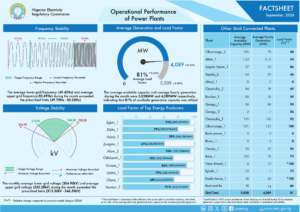
The factsheet provides insights into the operational efficiency of grid-connected plants, measuring how much of the available capacity was converted into actual energy supplied to the national grid.
Further breakdown of the performance data showed that Kainji_1, Afam_2, Egbin_1 and Ihovbor_2 emerged as top energy producers for the month.
The plants recorded high utilisation levels, with load factors of 98 per cent, 94 per cent, 94 per cent, and 91 per cent, respectively.
Kainji_1 led the chart with a 98 per cent load factor, making it the most utilised plant during the period, followed by Afam_2 and Egbin_1, which both recorded 94 per cent utilisation, while Ihovbor_2 recorded 91 per cent utilisation.
READ ALSO: AEDC launches app to ease bill payment, outage reporting, other services
Others include Shiroro_1, Jebba_1, Delta_1, Odukpani_1, Okpai_1, and Zungeru_1, with load factors of 86 per cent, 79 per cent, 79 per cent, 70 per cent, 68 per cent and 61 per cent, respectively.
The load factor is a measure of the utilisation of a power plant’s available capacity, calculated as the ratio of the average electricity generated over a period to the maximum possible generation.
NERC said the average lower grid frequency (49.43Hz) and average upper grid frequency (50.69 Hz) during the month exceeded the prescribed limits (49.75Hz-50.25Hz).
It explained that the monthly average lower grid voltage (304.90kV) and average upper grid voltage (350.28kV) during the month exceeded the prescribed limits (313.50kV-346.50kV).