













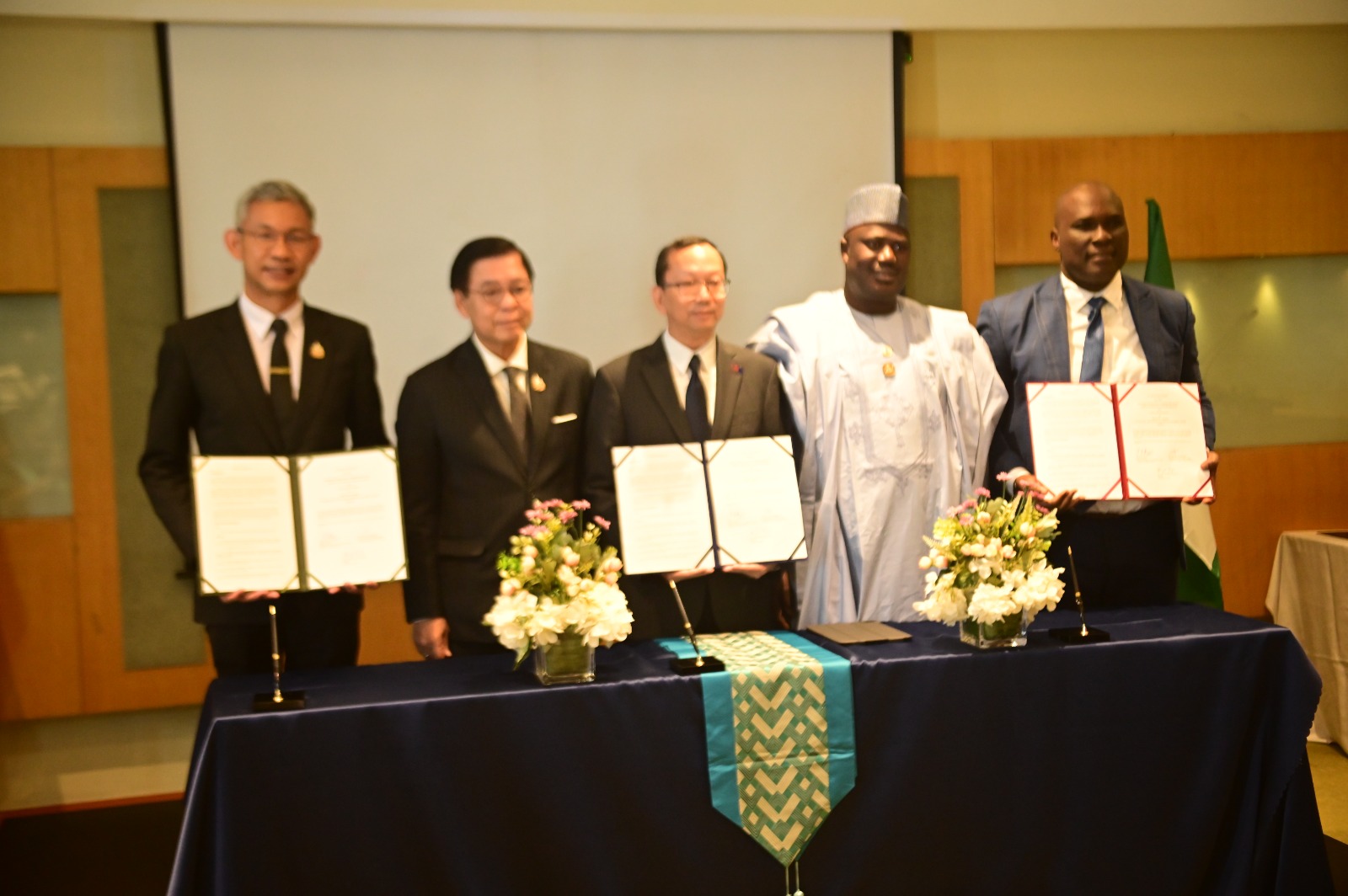
The Federal Government of Nigeria and the Kingdom of Thailand have signed new agreements on agriculture, cooperatives and innovation to drive the implementation of the Renewed Hope Cooperative Reform and Revamp Programme, RH-CRRP 2030.
The agreements were signed on Thursday in Lagos during a high-level engagement themed “Building Sustainable Partnerships: Connecting Youth, Innovation and Business between Thailand and Nigeria.”
This was disclosed in a statement on Friday by Ezeaja Ikemefuna, the chief information officer in the Ministry of Agriculture and Food Security.
Speaking at the event, the Minister of State for Agriculture and Food Security and Supervising Minister of Cooperative Affairs, Aliyu Abdullahi, said the signing marks the transition of RH-CRRP 2030 from policy formulation to practical implementation.
“Today, we have not merely witnessed the signing of documents; we have witnessed the strengthening of a partnership founded on knowledge, capacity development, innovation, institutional cooperation and shared prosperity,” he said.

RH-CRRP 2030 is a seven-pillar reform framework designed to reposition the Nigerian cooperative sector as an instrument for inclusive economic growth and distributed prosperity.
Mr Abdullahi said that the partnership directly supports Pillar 2 of RH-CRRP 2030: institutional strengthening, professionalisation and capacity building.
“At the heart of this pillar is a simple but fundamental principle: we cannot build strong and sustainable cooperatives without strong institutions and well-trained people,” he added.
He noted that the reform places deliberate emphasis on developing the knowledge, professional competence and leadership capacity of cooperative leaders, managers, regulators and members.
Partnership link to $1 trillion economy agenda
Linking the partnership to the Renewed Hope Agenda of President Bola Tinubu, the minister said the administration is determined to reposition cooperatives as stronger instruments for agricultural transformation, enterprise development, job and wealth creation, financial inclusion and sustainable livelihoods.
“As we work towards Mr President’s aspiration of building a one-trillion-dollar Nigerian economy within this decade, strengthening the capacity, professionalism and productivity of our cooperative institutions and the millions of Nigerians they serve will be critical,” he stated.
Mr Abdullahi stated that Thailand’s experience in agriculture, cooperative development, research and innovation presents important opportunities for mutual learning.
He added that Nigeria brings enormous agricultural potential, a vibrant youthful population and significant opportunities for investment.
He charged all institutions involved to move “deliberately from agreement to implementation” with practical programmes, clear timelines and measurable deliverables.
“Today’s signing marks not the conclusion of a process, but the beginning of a stronger and more productive chapter in Nigeria–Thailand cooperation,” he added.