













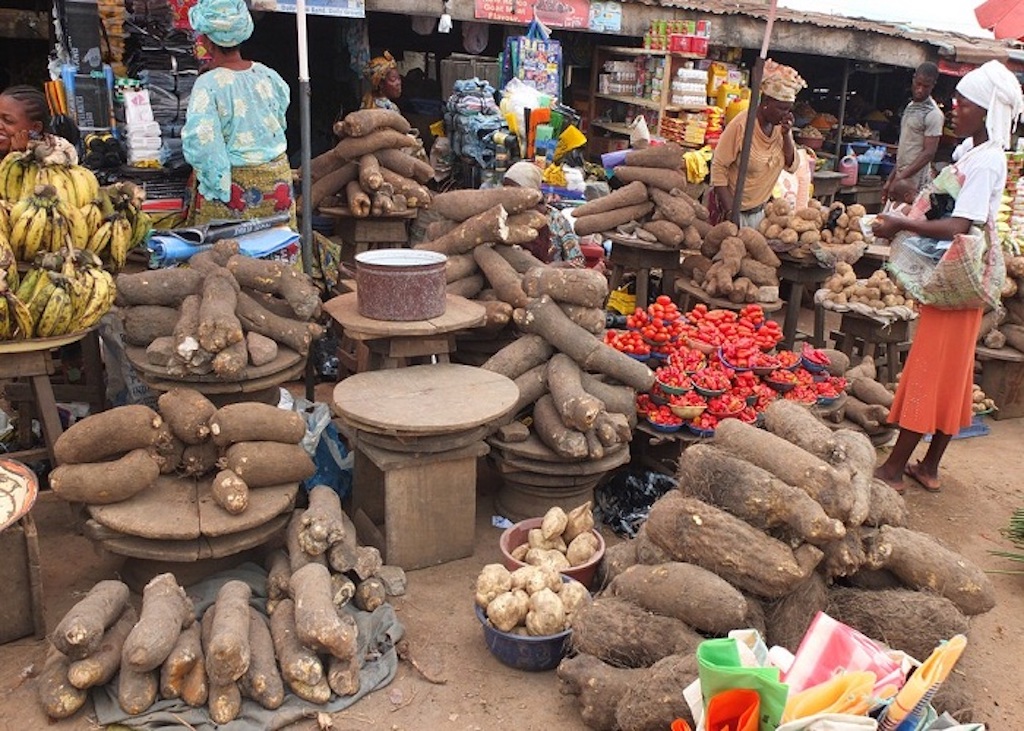
Prices of food items rose the most in Bayelsa, Ebonyi and Edo in February, the consumer price index (CPI) report released on Monday by the National Bureau of Statistics (NBS) has shown.
The report revealed that on a month-on-month basis, food price inflation was highest in Bayelsa at 8.81 per cent, Ebonyi at 8.51 per cent and Edo at 7.72 per cent.
It added that Katsina at -0.70 per cent, Nasarawa at 0.17 per cent, and Kano at 1.39 per cent recorded a decline in food inflation on a month-on-month basis.
The report said the food inflation on a year-on-year basis was highest in Kogi at 26.91 per cent, Adamawa at 23.12 per cent, and Benue at 21.89 per cent, while Katsina at 5.09 per cent, Bauchi at 7.09 per cent, and Imo at 7.65 per cent recorded the slowest rise in year on year inflation.
The statistics office said the food inflation rate in February was 12.12 per cent on a year-on-year basis.
It explained that this was 14.86 per cent points lower compared to the rate recorded in February 2025 (26.98 per cent).
“However, on a month-on-month basis, the food inflation rate in February 2026 was 4.69 per cent, up by 10.70 per cent compared to January 2026 (-6.02 per cent).
All items inflation
The report said in February, the all-items inflation rate on a year-on-year basis was highest in Kogi at 23.57 per cent, Benue at 22.85 per cent, and Anambra at 22.09 per cent, while Katsina at 7.78 per cent, Imo at 11.66 per cent and Ebonyi at 11.71 per cent recorded the lowest rise in headline inflation on a year-on-year basis.
READ ALSO: Nigeria’s inflation rate eases to 15.06% in February – NBS
However, on a month-on-month basis, all-items inflation was highest in Enugu at 5.92 per cent, Ogun at 4.39 per cent and Anambra at 4.11 per cent, while Zamfara at -2.14 per cent, Bauchi at -1.23 per cent, and Katsina at -1.06 per cent recorded a decline in the month-on-month inflation.
Less farm produce
The NBS further explained that the less farm produces and energy or core inflation, which excludes the prices of volatile agricultural produces and energy, stood at 15.88 per cent in February on a year-on-year basis; showing a decline of 9.78 per cent when compared to the 25.66 per cent recorded in February 2025.
On a month-on-month basis, the bureau said the core inflation rate was 0.89 per cent in February 2026, up by 2.58 per cent compared to January 2026 (-1.69 per cent).
“The average twelve-month annual inflation rate was 22.00 per cent for the twelve months ending February 2026, which was 5.25 per cent points lower than the 27.25 per cent recorded in February 2025,” the NBS said.