










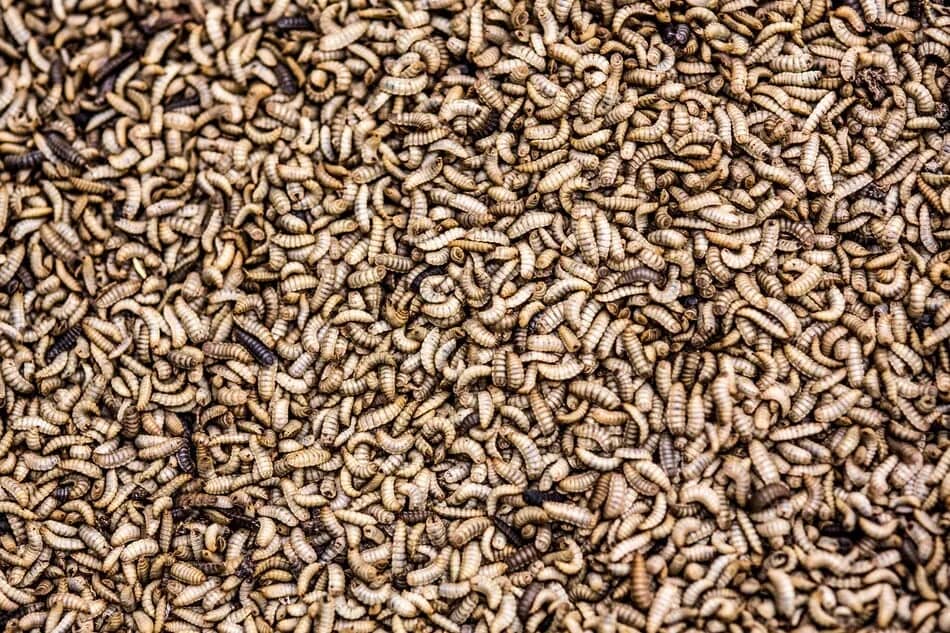
In a cluster of concrete ponds on the outskirts of Ibadan, Oyesola Peter bends over a tray of wriggling larvae.
To an outsider, it looks like waste. To Mr Peter, it is survival.
For years, the seasoned catfish farmer watched his profits disappear into one input: fish meal.
“It takes at least 70 per cent of the production cost. “Fish meal, the protein, determines whether the venture succeeds or fails,” he said.
He is not alone. Across Nigeria, fish farmers say the same thing: feed has become the business, and the fish are almost the by-product.
Now, Mr Peter and a growing number of farmers are fighting back with an unlikely weapon: ‘insects’.
“We culture insects and gather their larvae/pupae en masse, processing them to replace the most expensive and scarce fish meal,” Mr Peter said.
“It’s working. All we farmers need for sustainable production of animal protein from insects is not much compared to what fish meal has taken from us in the past.”
A crisis decades in the making
Nigeria’s fish farming industry is a vital contributor to the country’s Gross Domestic Product (GDP).
According to WorldFish, a non-profit research institute focusing on aquatic foods, Nigeria produces almost one million metric tons of fish per year, most of it consumed domestically, with about 10 per cent exported.
Demand is rising. The Food and Agriculture Organisation (FAO) says fish farming has grown by more than 200 per cent in recent decades as a result of consumer demand.
But growth has come with a painful cost. Aquafeeds typically account for 50 to 70 per cent of production costs, according to the FAO.
And at the centre of that cost is fish meal made from wild-caught anchovies, sardines and other small fish, ground into protein-rich powder for feed formulation.
“Long before now, big men in the industries have been exploiting our high seas for anchovies and sardines to be processed as fish meal. Which is in turn used as a vital nutrient for feed formulation,” Mr Peter said.
That model, he argues, is collapsing under its own weight.
“Currently, there is a serious depletion of such fish from the wild due to over-exploitation. This indicates that such action is not sustainable, as they keep on killing fish to feed animals and aquaculture,” he added.
The insect alternative
The search for sustainability, Mr Peter said, led farmers like him to a very good protein source, the ‘insect meal’.
The insects in question are not random. Farmers culture species specifically raised for feed, most commonly houseflies and black soldier flies harvest their larvae and pupae, dry them and process them into meal to replace fish meal in feed.
Globally, the move is gaining traction
In 2017, the European Union (EU) approved seven insect species for aquafeed under EU Regulation 2017/893.
According to the regulations, the insect species, namely housefly, black soldier fly, yellow mealworm, lesser mealworm, house cricket, Jamaica field cricket and branded cricket, were approved for feeding aquaculture animals.
A 2014 FAO review of catfish, tilapia, rainbow trout and several other fish species, as well as crustaceans, chickens and pigs, found that insect meal can replace between 25 per cent and 100 per cent of soymeal or fishmeal in animal diets without adverse effects.
For farmers like Mr Peter, that is not just a statistic. It is a lifeline.
“To this end, research and means of ensuring sustainability have driven some of us to discover a very good protein source as an alternative to the depleting fish meal, which is highly expensive now, and that is insect meal,” he said.
What it means for the pond
Speaking to THEPREVIEW MEDIA, Favour Chukwuma, a graduate of aquaculture and fisheries management, said insect meal does what fish meal does.
“It supplies the protein fish need to grow. But unlike fish meal, it does not depend on the dwindling stocks of wild fish. It can be produced locally, in small spaces, in weeks rather than seasons, and from organic waste that would otherwise be discarded.
“For smallholder farmers operating on thin margins, that local control matters as much as the price.
“When feed is 70 per cent of your cost, a cheaper, locally available protein does not just improve profit. It decides whether you stock your pond again next cycle,” she said.
Still a long road
Despite the promise, Mr Peter is clear that Nigerian farmers cannot do it alone.
“We need support from well-meaning Nigerians, Non-Governmental Organisations (NGOs) and the government,” he said.
That support, farmers say, would mean training on safe insect rearing and processing, standards for quality control, access to starter kits and low-cost drying equipment, and research tailored to Nigerian species and local feed formulations.
Without it, insect meal risks remaining what it is today in many communities: a farmer-led innovation, proven in practice, but not yet scaled.
For now, in Ibadan, Mr Peter continues to culture, harvest and process, turning what many would throw away into the protein that keeps his fish alive and his business afloat.